Mostrando entradas con la etiqueta People. Mostrar todas las entradas

lunes, 9 de junio de 2014

Agnesi witch

Maria Gaetana Agnesi


Nació en Milán el día 16 de mayo de 1718 y falleció en Milán el día 9 de enero de 1799 fue una filósofa y matemática italiana.

A los 9 años escribe un discurso defendiendo la educación de las mujeres.

A los 13 años tenía dominio del latín, el griego, el hebreo, el francés, el español y el alemán.

Tras la muerte de su madre, quiso recluirse en un convento pero su padre se negó.


A partir de los 20 años, Agnesi abandona toda actividad social y se concentra en el estudio de las matemáticas y la religión.
El monje matemático Ramiro Rampinelli tuvo gran influencia en su formación, despertando su interés por ese ambiente científico-monacal que presidió la vida de la matemática italiana.


En 1748 publicó su primer libro llamado Instituzioni analítiche ad uso della gioventù italiana que trataba del cálculo diferencial y el cálculo integral; desde álgebra hasta ecuaciones diferenciales.

En 1775 la Real Academia de Ciencias publica en París la edición francesa, y en 1801 se publica la inglesa.

Desde 1771 es directora del Hospicio Trivulzio de Milán donde está al cuidado de los menesterosos y enfermos y muere ella misma en la institución que dirigía, el 9 de enero de 1799.


...Translation in English...


Maria Gaetana Agnesi


She was born in Milan on May 16, 1718 and died in Milan on January 9, 1799, she was an Italian philosopher and math.

At 9 years she wrote a speech defending the education of women.

At 13 years she had command of Latin, Greek, Hebrew, French, Spanish and German.

After the death of her mother, she wanted to retreat to a convent but her father refused.


From age 20, Agnesi abandons all social activity and she concentrated in the study of maths and religion. The mathematical monk Ramiro Rampinelli had great influence on its formation, arousing their interest in that scientific-monastic environment that leaded her life.


In 1748 he published his first book called Instituzioni analítiche ad uso della gioventù italiana about differential calculus and integral calculus; from algebra to differential equations.

In 1775 the Royal Academy of Sciences in Paris published the French edition, and in 1801 she published the English one.


Since 1771 she was the director of the Hospice Trivulzio in Milan where she was in charge of the care of the sick and needy people, and she dies there on the January 9, 1799.

martes, 27 de mayo de 2014

How to save a life

Hoy vamos a hablar de PRIMEROS AUXILIOS. Iremos a las situaciones que se pueden producir con más frecuencia y repasaremos qué tenemos que hacer y cómo debemos actuar.


Lo primero de todo es saber que son:

Se denominan Primeros Auxilios a aquellas actuaciones o medidas que se adoptan inicialmente con un accidentado o enfermo repentino, en el mismo lugar de los hechos, hasta que llega asistencia especializada.

Normalmente, la primera persona que atiende una situación de urgencia o de emergencia, no es un sanitario. Por ello, sería conveniente que todos tuviéramos una serie de conocimientos básicos acerca de qué hacer o no ante estas situaciones.


Una vez que sabemos qué son los primeros auxilios, veremos cómo se debe actuar en cada una de estas situaciones:


OBSTRUCCIÓN DE LA VÍA AÉREA POR CUERPO EXTRAÑO (OVACE): atragantamiento

Síntomas de alerta: El signo universal de atragantamiento es llevarse las manos al cuello. Otros signos pueden ser la dificultad para hablar y el color azulado de la piel o la salivación por boca. 

Qué hacer: 
  • Avisar al 112
  • Si la víctima puede toser, animarla a que tosa.
  • Si la víctima no puede toser o ya no tiene fuerza para ello, pero sigue consciente, inicie compresiones abdominales. Para ello: 
  1. Preguntar a la víctima si se está ahogando y dígale que le va a ayudar.
  2. Maniobra de Heimlich: Colocarse detrás y abrazar a la víctima por la espalda con los dos brazos. En esta posición y de pie, colocar una mano cerrada apoyando el puño con el pulgar sobre el abdomen, justo por encima del ombligo y por debajo del final del esternón y la otra recubriendo la primera.
  3. Inclinar a la víctima hacia delante para facilitar la salida del objeto causante de la obstrucción.
  4. Presionar en ese punto, en dirección hacia dentro y hacia arriba.
  5. En embarazadas, personas obesas o menores de un año, las compresiones abdominales son sustituidas por compresiones torácicas. El lugar de compresión será en el centro del pecho.
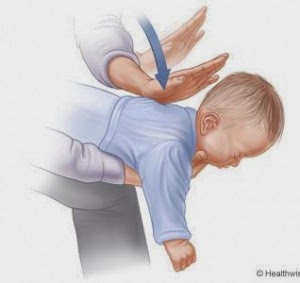
  6. En los menores de un año, colocar al bebé boca abajo, con la cabeza más baja que el resto del cuerpo, sobre uno de los brazos apoyado en las piernas. Alternar cinco golpes fuertes entre las escápulas con cinco compresiones torácicas, con dos dedos, en el centro del pecho. Hay que observar tras cada golpe, si sale el objeto. Hay que tener especial precaución sujetando al bebé.
  • Si la víctima perdiera el conocimiento:
  1. Alertar al 112 y solicitar un DESA (desfibrilador automático) que da una descarga al corazón para que este vuelva a funcionar correctamente. Tumbar a la persona en el suelo boca arriba, colocándose a su lado de rodillas e iniciar compresiones torácicas como si se tratara de una parada cardiorrespiratoria.
  2. Continuar con ellas hasta la llegada de los servicios de emergencia médicas, hasta agotarse y no poder continuar o hasta que la víctima tenga signos de vida: respire, tosa o se mueva.
  • Cuando lleguen los servicios de emergencias médicas, explicar lo ocurrido, las medidas realizadas y toda la información posible sobre la víctima.

Qué NO hacer:
  • Administrar los primeros auxilios a una persona en fase de atragantamiento si la persona se encuentra tosiendo y es capaz de hablar, ya que con tan solo la tos, puede desalojar el objeto de forma espontánea.
  • Realizar compresiones abdominales a menores de un año, podría provocarles daños mayores.
  • Realizar las compresiones fuera del lugar indicado, pues podría producir daños en costillas o intestino.
  • Intentar extraer el cuerpo extraño con los dedos a ciegas del interior de la boca.


ESGUINCE DE TOBILLO
  • Llamar a emergencias
  • Inmovilizar la parte dañada con una venda o pañuelo y mover lo mínimo posible a la víctima.

DIARREA
  • Se empieza con una dieta líquida: se proporciona agua a la persona debido a que está perdiendo mucha a partir de sus heces
  • Se continúa con una dieta astringente:
  1. Alimentos sin grasas y sin fibras en poca cantidad: arroz blanco, sopa de fideos, patata cocida, pollo o pescado a la plancha, jamón cocido...
  2. Alimentos con fibra en mayor cantidad progresivamente
  3. Alimentos más agresivos: legumbres, ensaladas, frutas, cereales integrales y leche

ACCIDENTE DE COCHE

Qué hacer:

1º Proteger 
  • Detener el vehículo en el arcén con la luz de corto alcance y ambos intermitentes conectados a la vez ("warning").
  • Ponerse el chaleco reflectante.
  • Observar desde el retrovisor si hubiera algún peligro antes de descender del vehículo.
  • Colocar los triángulos de emergencia donde se vean bien para los otros conductores que se aproximen (especial atención con las curvas cerradas y los cambios de rasante): 
a) En carreteras con doble sentido de circulación: uno delante del automóvil accidentado y otro detrás, a 50 metros del mismo. 
b) En carreteras de sentido único (autopistas o autovías) o con más de 3 carriles, coloque un triángulo detrás del vehículo a 50 metros del obstáculo y el otro a 100 metros. 
c) En casos de poca visibilidad, aumente la distancia (antes del inicio de la curva o del cambio de rasante).
  • Valorar los riesgos del entorno.
  • No fumar y prestar atención a los derrames de combustible.
  • Apagar las luces de los vehículos accidentados y desconectar el contacto quitando las llaves y poner el freno de mano. Tener especial cuidado con los airbags que no se hayan activado, podrían activarse y golpearle.
2º Avisar
  • Llamar al 112. Informar del tipo de accidente, número de heridos, localización exacta, posibles riesgos (derrames, incendios).
3º Socorrer
  • Realizar una estimación inicial de gravedad de las víctimas y proceder a prestar la asistencia básica.
  • Cubrir a la víctima con ropa si hace frío mientras se espera a los servicios de emergencias.

Qué NO hacer:
  • Deambular por la calzada. Colocarse en el arcén, o detrás del quitamiedos si lo hubiera, para evitar ser atropellado.
  • Introducirse en el vehículo siniestrado si está volcado o poco estable.
  • Abandonar a la víctima.

INFARTO AGUDO DE MIOCARDIO: ataque cardíaco

Qué hacer:
  • Guardar la calma. Mantener el control de la situación.
  • Colocar a la víctima en una posición en la que se encuentre cómoda y sin hacer ningún tipo de esfuerzos (sentado)
  • Llamar al 112 y apuntar la hora de inicio de los síntomas (dolor) especificando los que se han identificado.
  • Si la persona está consciente:
  1. Si ya ha tenido síntomas en ocasiones anteriores y tiene medicación, hay que adminístrarsela.
  2. Si no tiene medicación y no es alérgico a ella, se le puede dar media aspirina.
  • Aflojar todas las ropas que le estén oprimiendo y no le permitan respirar bien (cinturones, cuellos, bufandas...)
  • Controlar los signos vitales de la persona, y si queda inconsciente, valore la respiración:
  1. Si la víctima no respira o su respiración es ineficaz (boqueos, escaso movimiento torácico), prepararse para iniciar maniobras de RCP (Reanimación cardiopulmonar).
  2. Si respira colocarla en posición lateral y no perder de vista la respiración.
  • Controlar a la víctima y no dejarla sola en ningún momento hasta que llegue ayuda.
  • Cuando lleguen los servicios de emergencias médicas, explicarles lo que ha sucedido, las medidas realizadas y toda la información posible sobre la víctima.
Qué NO hacer:
  • Dar una medicación que no sea la que le hayan recetado al propio paciente.
  • Permitir que la persona haga cualquier esfuerzo, como andar o subir escaleras.
  • Dar comida o bebida a la víctima. Si se atraganta, los esfuerzos para toser o las náuseas empeoran la situación.
  • Poner nerviosa a la víctima, porque la angustia empeora la situación del paciente y aumenta la demanda de oxígeno del corazón.
  • Trasladar directamente a la víctima por sus medios sin esperar a los Servicios de emergencias médicas.


TORNIQUETE
  • Ponerse unos guantes de látex para minimizar el riesgo de transmitir una enfermedad
  • Materiales necesarios: un pañuelo o corbata y un palo que no se rompa. Si no hay palos disponibles, utiliza lo más similar.
  • Doblar el pañuelo por la mitad, de esquina a esquina, si se utiliza una corbata no se realiza este paso. El objetivo es formar un triángulo recto.
  • Agarrar las esquinas que forman el lado largo del triángulo y desdoblarlo de 6 a 9 cm hacia la tercera esquina.
  • Doblar una y otra vez de esta manera hasta llegar a la tercera esquina. Ahora se debe tener un vendaje de 7 a 10 cm de ancho y varias capas de espesor.
  • Atar el vendaje con una gasa alrededor de la extremidad correspondiente entre la herida y el corazón (el tronco del cuerpo), lo más cerca posible de la herida, pero por encima de la rodilla o del codo. Utilizar un nudo simple.
  • Colocar el palo en la parte superior del nudo y atar un segundo nudo en el palo.
  • Girar el palo hasta que estire el vendaje apretando lo suficiente como para detener el sangrado.
  • Atar los extremos de la venda alrededor de la extremidad y asegurar el palo con una gasa.
  • Apuntar a qué hora se ha realizado el torniquete y dejarlo a la vista para que lo sepan los médicos que atiendan a la persona.
  • Poner algo rígido en la zona de la herida para evitar movimientos, lo que podría reiniciar la hemorragia.
  • Trasladar a la persona lesionada lo más rápido al hospital. Comprobar el sangrado cada 10 min poco a poco aflojando el torniquete para ver si la coagulación ha detenido la hemorragia. Si es así, limpia y venda la herida. Si no, vuelve a apretar el torniquete y comprueba de nuevo cada 10 min.


...Translation in English...


Today we are going to talk about FIRST AIDS. We'll go to different situations and we will review what we have to do and how we have to act.


The first thing is to know what they are: 

They are called First Aids to those actions or measures initially adopted in a sudden accident or an ill person, in the same place, until the specialized assistance arrives. 

Typically, the first person who answers an urgent situation or emergency, is not a doctor. Therefore, it would be convenient that all have some basic knowledge about what to do or not in these situations.


Once we know what is first aid, we will see how to act in each of these situations:


AIRWAY OBSTRUCTION BY FOREIGN BODY (FBAO): choking

Warning signs: The universal sign for choking is putting their hands to the neck. Other signs are difficulty speaking and bluish skin or saliva by mouth.

Things we have to do:
  • Alert 112
  • If the victim can cough , encourage her to cough.
  • If the victim can not cough or no longer has the strength to do this, but still conscious , start abdominal thrusts. To do this:
  1. Ask if the victim is choking and tell him it will help .
  2. Heimlich Maneuver : Stand behind and embrace the victim in the back with both arms . In this position and standing , place one hand supporting the closed fist with the thumb on the abdomen, just above the navel and below the end of the sternum and the other covering the first .
  3. Lean the victim forward to facilitate the departure of the object causing the obstruction.
  4. Pressure at that point in direction inwards and upwards.
  5. In pregnant women, obese people , or less than one year , abdominal thrusts are replaced by chest compressions. The site of compression will be in the center of the chest.
  6. In under a year , placing the baby face down with the head lower than the rest of the body on one arm resting on the legs. Alternate five strong blows between the shoulder blades with five chest compressions with two fingers in the center of the chest. It should be noted after each hit, if it leaves the object. Be especially careful holding the baby.
  • If the victim lost consciousness :
  1. Alert the 112 and get an AED ( automatic defibrillator ) which gives a shock to the heart to make this working again . Overthrowing the person on the floor on your back , standing beside her knees and start chest compressions as if it were a cardiac arrest.
  2. Continue with them until the arrival of emergency medical services , until exhausted and unable to continue, or until the victim has signs of life : breathe , cough or move.
  3. When arriving emergency medical services , explain what happened , the measurements made and all possible information about the victim .

What we must NOT do :
  • Administer first aid to a person under choking if the person is coughing and is able to speak , because with only cough can dislodge the object spontaneously.
  • To perform abdominal thrusts under one year , it could cause them further damage.
  • Perform off-site compressions indicated , as it could cause damage to ribs or bowel.
  • Try to remove the foreign body with blind fingers inside the mouth.


SPRAIN ANKLE
  • Calling Emergency 
  • Immobilize the damaged part with a bandage or handkerchief and move the victim as little as possible.
DIARRHEA 
  • You start with a liquid diet: water is provided to the person because it is losing much from their feces
  • It continues with an astringent diet:
  1. Fat free foods without fiber sparingly: white rice, noodle soup, baked potato, chicken or grilled fish, ham ... 
  2. Foods with fiber in as many progressively 
  3. More aggressive foods: vegetables, salads, fruits, whole grains and milk

CAR ACCIDENT

Things we have to do:

1st Protect
  • Stop the vehicle on the shoulder with light intermittent short-range and both connected at once ( "warning" ) .
  • Wear a reflective vest .
  • Observe from the mirror if there is any danger before lowering the vehicle.
  • Place the warning triangle which look good to other drivers (special care with tight corners and elevation changes ) approximate :
a) On roads with two-way traffic : one in front of the wrecked car and one behind , 50 meters away.
b) In single roads ( freeways or motorways ) or more than 3 lanes sense , place a triangle behind the vehicle 50 meters from the obstacle and the other 100 meters .
c) In cases of poor visibility , increase the distance (before the start of the curve or hump ):
  • Assess the environmental risks .
  • No smoking and pay attention to fuel spills .
  • Turn off lights and unplug the damaged cars contact removing the keys and put the handbrake. Be particularly careful with the airbags that have not been activated , could be activated and strike .
2nd Notify
  • Call 112
  • Inform the type of accident, number of injured , exact location , potential risks ( spills, fires ) .
3rd Rescuing
  • Make an initial estimate of severity of casualties and proceed to provide basic care .
  • Cover the victim with clothing if cold while waiting for emergency services .

What we must NOT do :
  • Wandering on the road. Placed at the side or behind the guardrail if any, to avoid being hit .
  • Enter the damaged vehicle if overturned or unstable .
  • Leaving the victim.

ACUTE MYOCARDIAL INFARCTION : heart attack

Things we have to do:
  • Remain calm . Keep control of the situation.
  • Place the victim in a position that is comfortable without making any efforts (seated)
  • Call 112 and record the time of onset of symptoms (pain ) indicating which have been identified .
  • If the person is conscious:
  1. If you have had symptoms in the past and has medication , you have to administer it .
  2. If no medication and is not allergic to it , you can give half aspirin.
  • Loosen all the clothes that you are pressing and not allow you to breathe (belts, collars, scarves ... )
  • Monitoring vital signs of the person, and if it is unconscious , assess breathing :
  1. If victim is not breathing or breathing is ineffective ( boqueos , little chest movement ) , prepared to start CPR (cardiopulmonary resuscitation ) .
  2. If breathing place in recovery position and keep track of breath .
  • Control the victim and not leave her alone at any time until help arrives .
  • When arriving emergency medical services , explain what has happened , and measurements made all possible information about the victim .
What we must NOT do :
  • Give a medication other than that prescribed for the patient.
  • Allow the person to make any effort , such as walking or climbing stairs.
  • Give food or drink to the victim. If you choke , efforts to cough or gag worsen the situation.
  • Unnerve the victim , for trouble worsens the situation of the patient and increases the oxygen demand of the heart.
  • Move the exposed directly by its means without waiting for the Emergency Medical Services .


TOURNIQUET
  • Wear latex gloves to minimize the risk of transmitting a disease
  • Materials needed: a scarf or tie and a stick that will not break. If no sticks available , use the most similar.
  • Fold the scarf in half, corner to corner, if a tie is used this step is not performed. The objective is to form a right triangle.
  • Grasping the corners forming the long side of the triangle and unfold from 6 to 9 cm to the third corner.
  • Fold over and over again in this manner until you reach the third corner . Now one has to have a bandage from 7 to 10 cm in width and several layers thick .
  • Tying with a gauze bandage around the corresponding limb between the wound and the heart ( the trunk ) , as close to the wound , but above the elbow or knee . Use a simple knot.
  • Place the stick in the top of the knot and tie a second knot in the corner.
  • Rotate the stick until the bandage tightening stretch enough to stop the bleeding.
  • Tie the ends of the bandage around the limb and secure the post with gauze.
  • Aiming at what time the tourniquet was made and let in the light so you know the doctors caring for the person.
  • Put something hard in the area of ​​the wound to prevent movement which could restart the bleeding.
  • Move the injured person to the hospital as quickly . Checking bleeding every 10 min gradually loosening the tourniquet to see if clotting stopped the bleeding. If so, clean and bandage the wound. If not , re-tighten the tourniquet and check again every 10 min .


martes, 20 de mayo de 2014

La vida son instantes que se cruzan en el tiempo

La vida, camino que nos toca recorrer a cada uno por nuestra cuenta. Un largo camino donde aprendemos a entender el significado de la vida.

Parece ayer mismo cuando estaba en la GUARDERÍA con los primeros amigos que tendría en mi vida. Ahí solo me preocupaba por echarme a llorar porque creía que mi madre me dejaba en aquel lugar para no volver a por mí y tenía miedo. 

Luego llega el COLEGIO, lugar que más añoras en toda tu larga vida. Donde conocerás a personas que volverás a ver durante tu vida y que algunos de ellos no se separarán de ti. De aquí saldrán aquellas experiencias inolvidables que recordarás una vez que seas un adulto. Te reirás de las tonterías que hacías antes porque eras un moquillo inocente y siempre recordarás este tiempo.

Después llega el INSTITUTO, sitio que temes al entrar tu primer año debido a que sales del colegio siendo el más grande, y ahora entras a otro siendo de los más pequeños. Esto se debe normalmente a los gigantes que te encuentras por los pasillos y te da miedo acercarte a ellos vaya a ser que te derriben. Aquí tu preocupación es estudiar porque ya te queda menos para decidir qué hacer con tu vida y todo depende de tus resultados.

Con este período finalizará tu educación juvenil. Pasarás de ser un adolescente a un adulto. Pasarás de un mundo a otro.
¿Crees estar preparado? Nadie sabe lo que vendrá después.
¿Valdrá la pena todo el esfuerzo que hiciste durante esta parte de tu vida? ¿La has aprovechado o malgastado?
Ahora vive el presente y no quieras madurar tan pronto porque la infancia no nos la devuelve nadie. Suerte a todos con vuestro futuro!


...Translation in English...


Life are instants that cross in time


The life is a path that we have to go through by our own. A long way where we learn to understand the meaning of life.

It seems only yesterday when I was in the first DAYCARE with my first friends I would have on my life. There, I just think about crying  because I believed that my mother let me in that place and she would never come back for me and I was afraid.

Then comes PRIMARY SCHOOL, the place that you will miss during your whole. It's where you will meet people who you are going to see again in your life and some of them will not separate from you. From here will come out those unforgettable experiences that you will remember once you are an adult. You will laugh at the stupid things you did before because you were an innocent child and you will always remember this time .

Then comes the HIGH SCHOOL, the place which you will be afraid of when you enter in it in your first year because you leave the school being the oldest , and now you go to another place being the smallest. This is usually due to the giants that you find in the hallways and you're afraid to go near them because they can push you down . Here your concern is study because you have less time to decide what will you do with your life and it all depends on your results.

With this period your youth education will end. You will become an adult. You will go from one world to another.
Do you think you're ready? Nobody knows what will come next.
Is it worth all the effort you made during this part of your life? Have you taken advantage or have you wasted it?
Now live for today and don't want to grow up too soon because anybody won't give you back your childhood. Good luck with your future!


miércoles, 2 de abril de 2014

Hikikomori = Vergüenza

Un hikikomori es una persona que elige separarse de la vida social. Se conoce como un "marginado social". A menudo buscan grados extremos de aislamiento, debido a factores personales y sociales en sus vidas. Estos individuos padecen fobia social o problemas de ansiedad social. Esto también puede ser originado por agorafobia, trastorno de personalidad o timidez extrema.

Un hikikomori reacciona con un completo aislamiento social para evitar toda la presión exterior. Se encierran en sus dormitorios durante periodos de tiempo prolongados, incluso años. No tienen ningún amigo, duermen a lo largo del día y ven la televisión o juegan al ordenador durante la noche.
Todo esto hace de ellos un caso extremo de solteros parásitos (expresión japonesa para nombrar a aquellos que viven de las sopas instantáneas, viviendo en casa de sus padres para estar más cómodos).


Japón es el lugar donde más hikikomoris hay debido a que es un país muy desarrollado con una tecnología muy avanzada, por lo que el número de adolescentes que padecen esta enfermedad es mayor. Allí se considera una etapa que el niño ha de superar.

Una persona puede volverse hikikomori por varios factores. La principal causa son las burlas en el colegio. El individuo es objeto de burla, sus compañeros se ríen de él, lo cual provoca una tristeza e inseguridad en el individuo que lo obliga a aislarse del mundo por miedo a que se rían de él.


La falta de contacto social de estas personas y el aislamiento prolongado tienen un gran efecto en la mentalidad, con pérdida de habilidades sociales y moralidad. Ven el mundo a través de la televisión o los videojuegos.

Si el hikikomori regresa a la sociedad por su propia voluntad, tiene que afrontar el problema de haber perdido muchas de sus habilidades sociales, así como años de estudio, lo que agrava la reintegración. Temen que los demás descubran su pasado como hikikomori, y se muestran vacilantes con la gente, especialmente si son desconocidos.

Personalmente no me considero un hikikomori ni me gustaría serlo. Me gusta estar con la gente y conocer personas nuevas, aunque a veces puedo llegar a ser demasiado tímida.

"Ser un hikikomori significa ser la vergüenza de la familia."


...Translation in English... 


Hikikomori = Shame


A hikikomori is a person who chooses to be separated from the social life. It's known as a "social outcast". They often seeking extreme degrees of isolation, because of personal and social factors in their lives. These individuals suffer from social phobia or social anxiety problems. This can also be caused by agoraphobia, personality disorder or extreme shyness.

A hikikomori reacts with a full social isolation to avoid any external pressure. They lock themselves in their rooms for extended periods of time, even years. They have no friends, they sleep during the day and they watch TV or play computer overnight. 


All this makes them an extreme case of parasite singles (Japanese expression to name those who live by instant soups, living in their parents' house to be more comfortable).

Japan is where there are more hikikomoris because it is a highly developed country with advanced technology, so the number of youngsters with this disease is higher. It is considered as a stage that the child has to overcome.

A person can turn into a hikikomori by several factors. The main cause is the teasing at school. The individual is derided by his colleagues who laugh at him, making him feel sad and insecure, forcing him to withdraw from the world for fear of being laughed at him.


The lack of social contact of these people and the prolonged isolation have a great effect on their minds, losing social skills and morality. They see the world through television or video games.

If the hikikomori returns to society by his own, he has to face the problem of having lost many of his social skills and a few years of study, which make more difficult to reintegrate in the society. They fear that others discover their past as hikikomori, and they are hesitant to people, especially if they are strangers.

Personally I don't consider myself a hikikomori and I wouldn't like to be one of them. I like being with people and meet new people, but sometimes I can be too shy.


"Being a hikikomori means to be the shame of the family."

domingo, 6 de octubre de 2013

Violence

Bullying, Battering and Mobbing are 3 ways of harassment

  • Bullying→ physical  or psychological abuse among schoolchildren performed repeatedly over a period of time


  • Battering→ type of violence which involves physical contact

  • Mobbing→ psychological or even physical violence, which produced fear, contempt, or discouragement on the employee, to his job. It can occur inside or outside of this job during a period of time


jueves, 3 de octubre de 2013

Violencia

Bullying, Battering y Mobbing son 3 formas de acoso


  • Bullying → maltrato físico o psicológico realizado entre alumnos escolares de forma repetida durante un periodo de tiempo determinado


  • Battering → tipo de violencia que implica contacto físico


  • Mobbing → violencia psicológica o incluso física, que trata de producir, sobre el trabajador afectado, miedo, desprecio, terror o desánimo hacia su trabajo. Puede ocurrir dentro o fuera de dicho trabajo durante un periodo de tiempo determinado